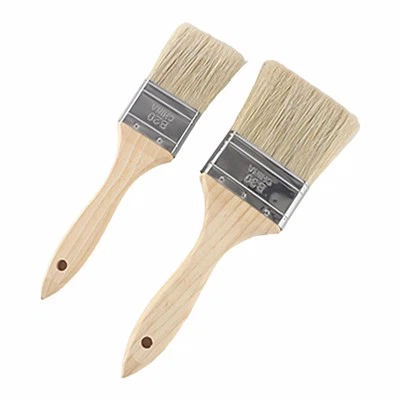
As an essential tool set for painting operations, paint brush sets have developed a relatively clear classification system due to differences in application scenarios and functional requirements. Classification based on structural shape, bristle material, intended use, and applicable paint types helps users make targeted selections according to specific working conditions, thereby improving painting quality and work efficiency.
Classified by brush head shape, paint brush sets can be divided into flat brushes, round brushes, angled brushes, flat-slanted brushes, and fan brushes. Flat brushes have rectangular, straight bristles, suitable for large-area flat coating, covering a wide area in one stroke, and are commonly used for primer and topcoat application on walls, ceilings, and panels. Round brushes have round or semi-circular brush heads, facilitating the formation of a uniform coating on curved surfaces, cylinders, and corners, and are often used for painting furniture legs, railings, and pipes. Angle brushes have bends or notches on the back, allowing them to reach deep into right-angle gaps and grooves, suitable for fine coating of window frames, door edges, and decorative lines. Flat, angled brushes have bristles on one side that are angled, which helps control the coating width at edges and junctions, and are often used for finishing and demarcating edges. Fan-shaped brushes, with their bristles arranged radially, can create soft transitions in artistic finishes or gradient effects.
Based on bristle material, brushes are mainly classified into natural bristle brushes, synthetic fiber brushes, and mixed-bristle brushes. Natural bristles, derived from pig bristles or other animal hair, have excellent paint retention and elasticity, maintaining smooth application and clear edges in solvent-based paints, oil-based paints, and high-viscosity coatings. They are suitable for applications requiring high-quality coatings, such as metal corrosion protection and wood coatings. Synthetic fiber brushes are made of chemical fibers such as nylon and polyester, are chemically resistant, easy to clean, and perform excellently with water-based paints, making them particularly suitable for environmentally friendly latex paints and multiple coats in interior decoration. Mixed-bristle brushes combine the advantages of natural and synthetic fibers, maintaining a certain paint retention capacity while improving durability and ease of cleaning, broadening the range of applicable paints. They are often used in comprehensive projects involving alternating application of multiple paint types.
Based on application, paint kits can be categorized into general-purpose kits and specialized kits. General-purpose kits typically include a variety of common brush heads in different shapes and sizes to meet the painting needs of various surfaces, including flat surfaces, vertical surfaces, and corners, making them suitable for home decoration, minor repairs, and general engineering projects. Specialized kits are designed for specific processes or substrates, such as fine-tipped brush sets specifically designed for wood grain coloring, wide-width, high-durability brush sets for ship and bridge corrosion protection, or fine-bristled fan-shaped and flat-angled brush sets used in art painting. These kits are more targeted in terms of bristle hardness, shape precision, and solvent resistance.
Based on the type of paint applicable, paint kits can be categorized into oil-based paint kits and water-based paint kits. Oil-based paint kits are mostly made of natural bristles, which have good compatibility with solvent-based paints, reducing frizz and dripping during application. Water-based paint kits are mainly made of synthetic fiber brushes, which have good water resistance and are easy to clean, aligning with the trend of environmentally friendly and safe construction. Some kits combine bristles and multiple brush head sizes to accommodate both types of paint, increasing flexibility for cross-scenario use.
When selecting a paintbrush set, the surface characteristics of the work surface, the properties of the paint, the working environment, and the project timeline should be considered comprehensively. For example, a general-purpose set mainly composed of flat-edged synthetic fiber brushes is suitable for painting large areas of interior walls; a specialized set consisting of wide-width natural bristle brushes is suitable for outdoor metal corrosion protection; and a combination of angular and fine-tipped brushes can be used for fine wood finishing. A reasonable understanding and matching of categories can maximize tool efficiency while reducing paint waste and rework rates.
In general, the classification system of paintbrush sets is constructed by shape, material, purpose, and paint compatibility, reflecting a close fit between tool design and construction needs. Mastering the classification principles and applying them flexibly in practice is an important guarantee for achieving efficient and high-quality painting operations.