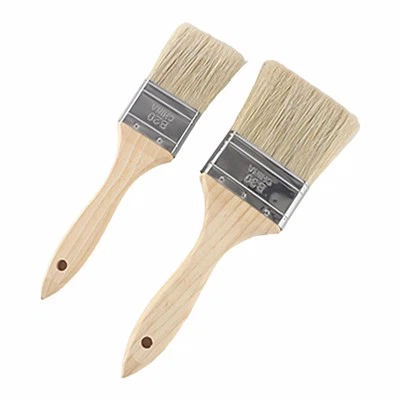
In recent years, with the continuous development of fields such as architectural decoration, furniture manufacturing, and industrial protection, paint roller brushes, as an important hand tool in the painting process, have shown a clear trend of upgrading. Driven by both diversified market demand and technological progress, the roller brush industry is shifting from meeting single functions to comprehensively improving its overall performance, including high efficiency, environmental protection, and intelligence, gradually building an industry structure that meets the construction requirements of the new era.
Environmental protection is currently the most significant evolutionary direction in the industry. Stricter global restrictions on volatile organic compound (VOC) emissions are driving the transformation of coating systems towards water-based and solvent-free low-pollution types, directly prompting adaptation innovations in roller brush materials and structures. On the one hand, the research and development of brush bristle materials focuses more on compatibility with water-based coatings, reducing paint residue and uneven penetration by improving fiber hydrophilicity and surface energy, thus lowering the risk of secondary pollution. On the other hand, some companies are exploring biodegradable or recyclable roller core and handle materials to reduce the environmental burden after tool disposal from the source, echoing the macro-guidance of green manufacturing.

The demand for higher efficiency focuses on the complexity of construction scenarios and the pressure of labor costs. For scenarios where traditional roller brushes struggle to cover high-altitude areas and irregularly shaped substrates, lightweight design and modular expansion have become key breakthroughs. For example, the widespread adoption of quick-release extension rod interfaces, coupled with the rapid replacement of multi-specification bristle sleeves, allows a single tool to flexibly handle substrates of varying areas and textures.
Simultaneously, by optimizing the bristle density gradient and arrangement logic, new roller brushes further shorten the effective working length after a single dip while maintaining coating uniformity, increasing coverage per unit time and helping construction workers reduce labor intensity and improve project progress.
While intelligent exploration is in its early stages, it has already shown potential. Some cutting-edge designs attempt to integrate sensors into the handle, monitoring the applied force angle and movement speed to provide feedback on construction data, assisting operators in correcting technique deviations. Other research focuses on embedding self-cleaning functions, using microstructure design or special coatings to reduce paint adhesion and simplify subsequent cleaning processes. Although these innovations have not yet been commercially deployed on a large scale, they point the way for the industry towards a future path of collaborative optimization between "tools, people, and processes."
Overall, the paint roller brush industry is moving beyond the limitations of traditional tools, deeply integrating into the upgrading wave of modern coating systems with environmental protection as the bottom line, efficiency as the core, and intelligence as an extension. This trend will not only reshape the market competitiveness of products but also provide more sustainable and economical solutions for downstream application fields, driving the entire coating industry chain towards high-quality development.